
A maiden voyage into Istanbul rarely leaves the Bosphorus. The aqueous passage is so vast and voracious, it swallows all the space around it, and with that, all your time. At the confluence where its currents meet the Marmara Sea, life moves in a mesmerizing tableau. Straddling the frontier between Europe and Asia is a microcosm of ferries and pedestrians. Across belts of water, they orbit and glide at speeds equally frenetic and languorous.
On the Galata Bridge that arches over the inlet of the Golden Horn, fishermen perch and wait on the whims of fortune. From dawn to dusk, a delicate curtain hangs from their rods. Under the bridge, the fishing lines glisten like threads of silk. Ever so often, one is hoisted and flung back into the water with a gentle whish, as quiet as the sweep of a self-winding watch.


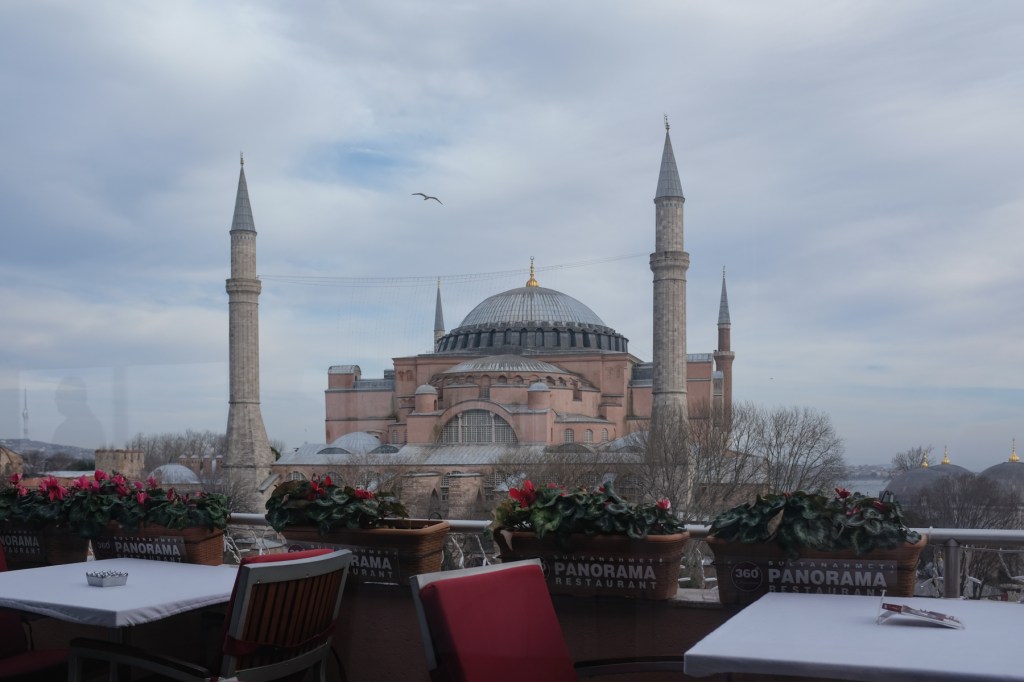
The historic core of Istanbul is contained within a peninsula not much larger than five square miles. Once, it was called Constantinople, and before that, Byzantium. What began as a Greek settlement by the banks of the Bosphorus would go on to become the capital of the most powerful empire in the Mediterranean and the cradle of Orthodox Christianity. From the middle of the fifth to the early 13th century, Constantinople was the largest, wealthiest, and most revered city in Europe, lavished with accolades and titles such as New Rome and Megalopolis—the “great city.” Following the collapse of the Eastern Roman (Byzantine) Empire in 1453, it continued to serve as the capital of the Ottoman (Turkish) Empire, becoming a hub between Europe and the Middle East.
The modern-day area of Constantinople, now known as the district of Fatih, is home to Istanbul’s most significant monuments. Best known among them is the rose-colored Hagia Sophia. Upon its completion in 537, it was the largest church in the world. Underneath a gilded mosaic canopy of Orthodox figures and multi-winged seraphim hang eight colossal roundels. Inscribed with Arabic calligraphy, they bear the names of Allah, the Prophet Muhammed, his sons, and the first four caliphs, or leaders, of Islam. The juxtaposition of Christian and Islamic elements mirror the religious changes that have played out on the peninsula.

Just adjacent to the Hagia Sophia lies a sunken marble forest. The Yerebatan Sarnıcı, also known as the Basilica Cistern, is a palatial-looking underground reservoir dating back to the sixth century. Forgotten for hundreds of years under Constantinople’s walls, the hazy details of its rediscovery in the 1500s accentuate the cistern’s mystique.
Towards the other end of Sultanahmet Square facing the Byzantine-era monuments is the Blue Mosque. Built between 1609 and 1616, it is one of the most iconic examples of Ottoman architecture. More than 20,000 tiles in swirling floral motifs and arabesque patterns adorn the mosque’s interior, bathing the prayer halls in a luscious blue glow.


There are other parts of Istanbul that resemble Western Europe, if only for the blink of an eye. Across the Galata Bridge from Fatih is the commercial and entertainment quarter of Karaköy. Dominating the hillside is the Galata Tower, a former Genoese watchtower-turned-prison characterized by its thick and burly Romanesque build. Just north, on İstiklal Avenue, decorative lights in the shape of shooting stars create the illusion of a festive village in northern France. But behind the vitrines of the stores, in place of French viennoiseries are glazed baklava and a rainbow assortment of jelly lokum, also known as Turkish delights. Food carts stocked with mussels and lemon squat the streets and plazas. A closer look, however, reveals something more about them: the plump, orange mollusks are stuffed with rice. They are midye dolma, a beloved street snack found in Türkiye’s coastal cities.
A diverse ensemble of actors fill Istanbul’s crowded stage. Most of the cast are clad in everyday clothes, but a few are dressed to remind the audience of their setting: at the edge of a continent and the beginning of another. Elders pace along in red velvet fez hats, outpaced by groups of chattering women in satin headscarves. Occasionally, men with scalps etched in maroon or purple pinpoints make a cameo, stepping out into the city with a new head of follicles, sometimes still oozing blood. No one bats a second eye. Although no longer a capital, Istanbul has become the global mecca for hair transplants.
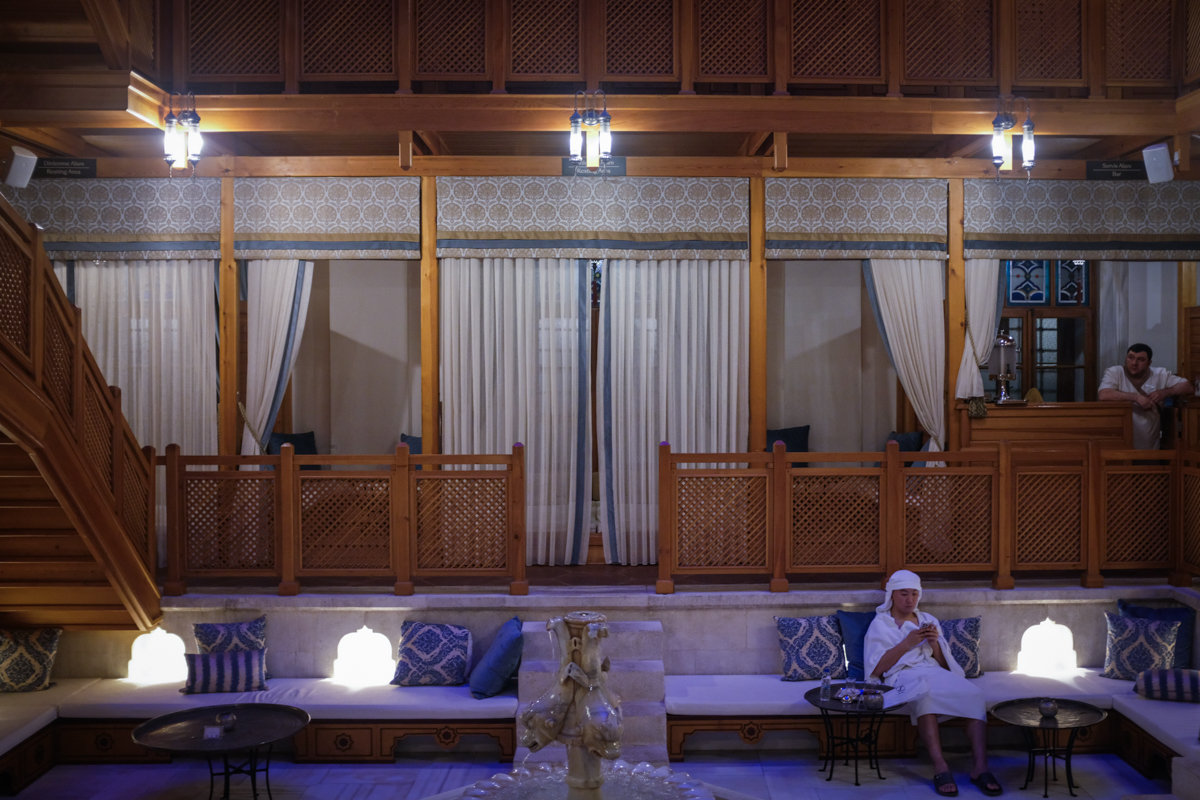
In hidden corners of the city, moistened by murmurs and the sound of fountains flowing into copper bowls, are the hammams. Some, like the Firuzağa Hamam, are musty, a masculine and seedy meeting place with tepid water and dimly lit communal alcoves. Others, like the Hürrem Sultan Hamamı, are opulent, glistening, and fit for royalty. The latter, commissioned by the Ruthenian-born wife of Sultan Suleiman the Magnificent (the longest-reigning sultan of the Ottoman Empire) dates back to 1556. Like most Turkish baths, the centerpiece of the spa is a massive göbek taşı. On this hot marble table, guests are treated to a full-body scrub with a kese, a rough glove adept at sloughing off old skin. A silky bubble bath follows. By plunging a mesh bag into soapy water and then filling it with air, the bathhouse masseur, or tellak, draws out thick clouds of foam that envelope the body. Regardless of the hammam, the ritual of the Turkish bath is an invitation to partake in the art of indulgence.
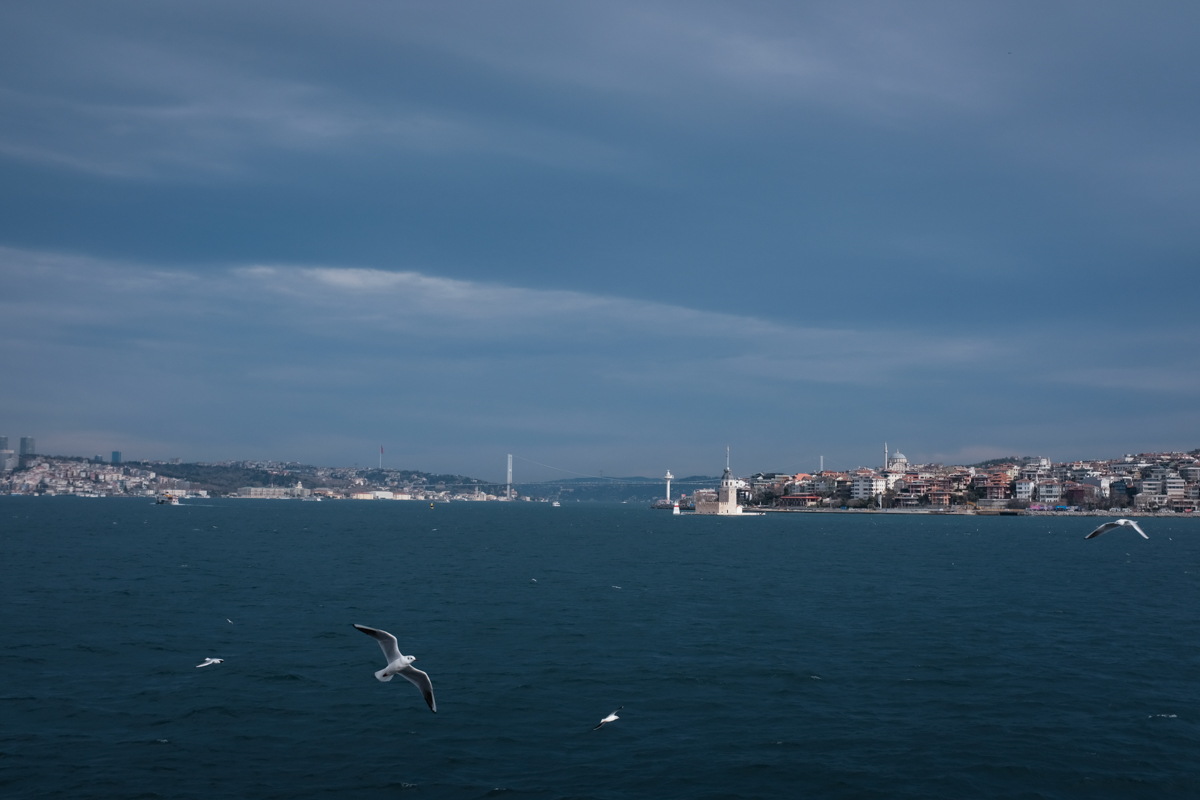
Continent-hopping is something that Istanbulites take for granted. From the Eminönü waterfront in Fatih and the opposing bank of Karaköy, ferries regularly traverse the Bosphorus east to Kadıköy, a district on the Asian side of the city. The short voyage to Asia Minor, or Anatolia, is accompanied by hungry gulls and passes landmarks such as the floating Maiden’s Tower. In Anatolia, Istanbul relaxes itself. With fewer tourist attractions, Kadıköy’s charm is in its community. It is a place where sports teams go to celebrate, where fathers and grandfathers pick fresh fish from market, and where freethinkers ramble with insouciance in the beer garden of Nâzım Hikmet Kültür Merkezi. The neighborhood of Moda, steps away from the seafront, is particularly inviting. Under the sun, its laid-back cafés are frequented by people and the city’s many stray cats alike. Separated by the prim and ceremonious Fatih by only a strait, Anatolian Istanbul feels a world away.


 Gregory Gioro